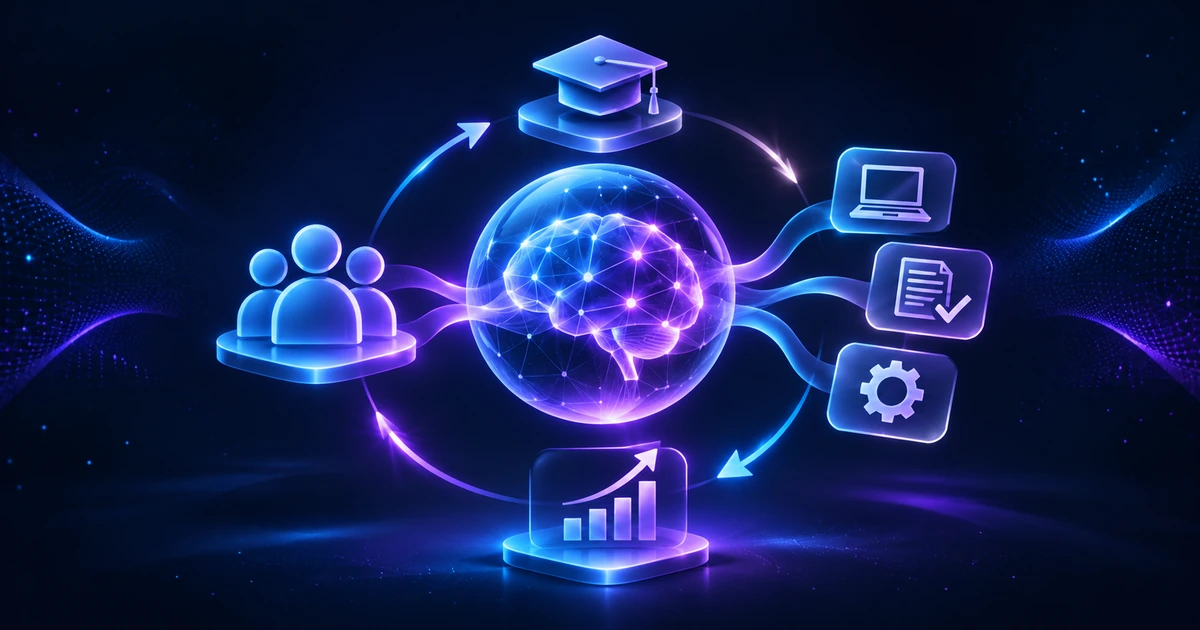
AI in the workplace is already changing how people complete tasks, build skills, and enter the labor market—but not in the simple way many headlines suggest.
Some workers are completing tasks faster with AI. Some companies are redesigning workflows around it. And some early-career workers are entering a labor market where tasks once assigned to junior employees can now be assisted or partially automated.
But the effects are far from uniform. In some settings, AI produces meaningful productivity gains. In others, the improvement is small, difficult to measure, or even negative.
That makes the familiar debate—“Will AI replace workers?”—too narrow. A better question is already becoming more useful: How is AI changing what people do at work, who companies hire, and which skills remain valuable?
The main idea: AI’s workplace impact is not just about whether a job can be automated. It is about how tasks are redistributed between people and machines, how hiring changes, which skills gain importance, and whether organizations can turn AI capability into measurable results.
AI in the Workplace Has Moved Beyond the Experiment Stage
Generative AI is no longer something used only by early adopters testing a new technology.
Data from the Generative AI Adoption Tracker indicate that about 40.5% of employed Americans ages 18–64 reported using generative AI for work in the third quarter of 2026, up from roughly 33.3% in the third quarter of 2024.
Yet adoption is not the same as dependence. Only about 11.5% reported using generative AI on every workday. Someone who occasionally asks an AI assistant to summarize a document is having a very different workplace experience from someone whose daily workflow has been rebuilt around AI.
So the important story is not simply that more people are using AI. It is what happens when AI moves deeper into the tasks that make up their jobs.
The First Mistake to Avoid: Confusing Tasks With Jobs
Much of the anxiety around AI and employment begins with a misleading leap: if AI can perform part of a job, the entire job must be at risk.
The International Labour Organization’s global analysis of generative AI and jobs estimated in 2025 that about one in four workers worldwide were in occupations with some degree of exposure to generative AI. Yet only 3.3% of global employment fell into the highest exposure category.
More importantly, exposure is not displacement.
| Concept | What It Actually Means |
|---|---|
| AI exposure | AI may be capable of affecting some tasks within the work. |
| Automation | AI performs a particular task with less human involvement. |
| Augmentation | A worker uses AI to perform a task differently or more efficiently. |
| Job displacement | Demand for workers or positions actually declines. |
Most jobs are bundles of activities. A single role can involve writing, research, communication, judgment, verification, negotiation, handling exceptions, and taking responsibility for the final result.
AI might generate the first draft of a report, for example, while a person still needs to decide what belongs in it, verify the claims, adapt it to the situation, and take responsibility for what happens next.
A task becoming automatable is not the same as a job becoming unnecessary.
This distinction also helps explain why studies of AI in the workplace can produce dramatically different productivity results.
AI Can Make Work Faster—But Not Every Kind of Work
Some of the strongest research on AI in the workplace shows that the technology can produce substantial gains when it fits the task.
A study of 5,172 customer-support agents, published in The Quarterly Journal of Economics, found that access to a generative AI assistant increased the number of issues resolved per hour by about 15% on average. The gains were particularly strong among less experienced and lower-performing workers.
That makes intuitive sense in work where employees repeatedly encounter related problems. An AI assistant can make useful language, knowledge, and patterns from previous interactions easier to access, allowing some workers to perform more like experienced colleagues.
But productivity gains are not automatic.
In a randomized METR study, 16 experienced open-source developers completed 246 tasks in repositories they already knew. When they were allowed to use early-2025 AI tools, they took about 19% longer to complete the work.
One of the most interesting findings was that the developers believed AI had made them faster.
The study is small, focused on a particular group of experienced developers, and used tools that have since evolved. Its 19% result should not be generalized to software development as a whole. But it exposes an important weakness in the assumption that AI-generated output automatically translates into saved time.
Prompting, reviewing, correcting, and integrating AI output all take time. The relevant question is therefore not “Can AI perform this step?” but “Does AI improve the complete workflow once all the extra work is counted?”
The Bigger Employment Signal May Be Hiring, Not Layoffs
When people imagine AI disrupting employment, they often picture companies replacing existing workers. But one of the most important signals emerging in 2026 concerns something less visible: who gets hired in the first place.
Research from Stanford’s Digital Economy Lab, using payroll data covering millions of U.S. workers, found a notable divergence among workers ages 22–25 in occupations with high exposure to generative AI.
By mid-2026, employment for these early-career workers was about 19% below the path that would have kept pace with workers in less-exposed occupations.
Crucially, the difference appeared primarily through weaker hiring rather than unusually high rates of workers leaving their jobs.
That suggests a form of disruption that can be easy to miss. A company does not need to replace an existing employee for technology to affect employment. It can simply decide that a smaller number of new hires is sufficient when existing employees can handle more work with AI.
Separate Census research released in 2026 adds another signal. In adjusted estimates, graduates from majors in the highest decile of AI exposure had a 5-percentage-point lower probability of initial employment and 13% lower initial full-quarter earnings.
These findings are important, but they do not prove that AI alone caused the differences. Hiring is influenced by broader economic conditions, the studies rely on measures of AI exposure rather than direct observation of every employer’s technology use, and the effects cannot automatically be generalized to every young worker.
What the evidence supports: Some early-career workers in highly AI-exposed areas are showing signs of labor-market pressure, particularly through weaker hiring. That is a much more defensible conclusion than saying AI is already causing mass unemployment.
Why the Labor-Market Picture Is Still Mixed
If AI were already producing the same employment effect everywhere, we would expect the evidence to point consistently in one direction. It does not.
A Danish study covering roughly 25,000 workers and 7,000 workplaces across 11 AI-exposed occupations found evidence that generative AI was changing tasks, but it did not find large average effects on recorded earnings or hours during the early period studied. The researchers could rule out average effects larger than roughly 2% on those outcomes.
This does not invalidate the U.S. evidence on early-career hiring. The studies examine different workers, countries, time periods, and outcomes.
Instead, the contrast reveals something important about the current stage of AI in the workplace: change can appear in specific groups or tasks long before it produces a clear economy-wide employment effect.
For now, uneven transformation is a better description than universal displacement.
AI Creates an Entry-Level Paradox
There is a particularly interesting tension in the evidence around less experienced workers.
On the job, AI can help them substantially. The customer-support study, for example, found larger gains among less experienced workers. AI can make knowledge that once took years to accumulate easier to access during a task.
But making junior workers more productive does not necessarily mean companies will hire more junior workers.
A business may discover that a smaller team can handle the same workload. In that situation, AI can improve the performance of the junior employees who already have jobs while reducing the number of new positions the company needs to open.
That leads to a second problem: how future experts will develop.
Early-career work often includes repetitive or lower-level tasks, but those tasks can also be part of the learning process. Employees build judgment by doing the work, making mistakes, receiving feedback, and gradually handling more difficult cases.
If AI performs more of that practice, organizations may need to become more deliberate about how junior employees gain experience.
A small 2026 experiment involving programmers learning a new Python library illustrates the concern. Participants using AI assistance showed weaker immediate mastery afterward, without a statistically significant average improvement in completion time.
The experiment is too small and short-term to prove that AI causes long-term deskilling. But it demonstrates why finishing a task and learning how to perform it are not the same outcome.
The Valuable Skill Is Not Simply “Knowing AI”
As AI in the workplace changes the tasks inside jobs, workers naturally want to know which skills will matter next.
The answer is more practical than becoming an AI engineer or mastering every new prompting technique.
For many workers, the useful combination will be the ability to use AI within a real domain while retaining enough expertise to judge the result.
- Domain expertise: understanding the work well enough to recognize incomplete, inappropriate, or incorrect AI output.
- Verification: checking important claims, calculations, code, recommendations, or generated content instead of treating output as authoritative.
- Problem framing: deciding what should be delegated to AI, what context it needs, and what a useful result actually looks like.
- Workflow judgment: recognizing when AI removes friction and when it simply adds another step.
- Data and privacy awareness: understanding what information can safely be shared with an AI system and which organizational rules apply.
In that sense, AI literacy is not just the ability to prompt a model. It is knowing when to use AI, when not to use it, and how to tell whether its output deserves to be trusted.
Why Buying AI Is Easier Than Transforming Work
For businesses adopting AI in the workplace, access to the technology does not guarantee meaningful organizational improvement.
A large field experiment involving 7,137 workers across 66 companies examined the introduction of Microsoft 365 Copilot. During months four through six, access to the tool reduced time spent in email by about 1.4 hours per week in the intention-to-treat estimate.
Yet the researchers did not detect a broad transformation in the quantity or composition of work simply because employees received access to the tool.
The distinction matters. If an employee saves time writing an email, the business does not automatically receive the same amount of additional productive output. That time might shift to another task, more communication, additional review, or simply a different pattern of work.
Buying AI access is not the same as redesigning a workflow.
The companies most likely to learn something useful from AI adoption are therefore the ones that measure what happens to the entire process—not just how many employees activate the software.
A Better Way for Businesses to Evaluate AI
Instead of starting with “Where can we add AI?”, businesses can start with a more useful question: Which workflow has a measurable problem that AI might improve?
- Choose a specific workflow. Identify a recurring process with clear inputs, outputs, and existing friction.
- Measure the baseline. Record current time, quality, correction effort, cost, or failure rates before introducing AI.
- Test representative cases. Include difficult examples and exceptions—not only demonstrations where the AI performs well.
- Measure quality alongside speed. Faster generation has little value if the saved time is consumed by review and correction.
- Define human responsibility. Decide where verification, approval, escalation, privacy controls, and accountability are still required.
Only after the workflow shows a meaningful improvement does deeper integration or automation become easier to justify. Our guide to building a practical AI workflow explains how to approach that process step by step.
What Workers Can Do Now
Workers do not need to chase every new AI product to adapt effectively to AI in the workplace.
A better starting point is the work they already do.
Which tasks are repetitive and digital? Which require judgment? Which could be accelerated safely? Which outputs are difficult to verify? And which tasks are valuable partly because doing them develops expertise?
Testing AI against a real recurring task can reveal much more than learning dozens of isolated prompting tricks. The useful measure is not whether AI produces an impressive answer, but whether the final accepted work becomes faster, better, or less costly after review and correction are included.
Workers should also be careful not to outsource the knowledge they will later need to supervise the technology. For someone early in a career, efficiency and learning are not always the same objective. For an experienced professional, the key question may be whether AI removes a genuine bottleneck or simply creates more work to check.
And as AI makes plausible text, code, analysis, and recommendations easier to generate, domain knowledge may become more—not less—important for distinguishing a useful result from a convincing mistake.
So, Is AI Replacing Jobs?
In some companies and types of work, AI is already influencing staffing and hiring decisions. Some tasks are being automated, and there are credible signs of pressure in parts of the early-career labor market.
But the evidence available through 2026 does not support turning those cases into a claim that AI is already causing economy-wide mass unemployment.
What we can see more clearly is that AI in the workplace is reorganizing work unevenly rather than producing the same effect everywhere.
Some workers become more productive. Some tasks require fewer human hours. Some new hires may face a higher bar. Other workplaces adopt AI without seeing large measurable changes in hours, earnings, or the overall structure of work.
Forecasts about millions of jobs being created or displaced can help explore possible futures, but they remain forecasts. Their outcomes depend on adoption, investment, regulation, business demand, worker adaptation, and technologies that are still changing rapidly.
The Workplace Is Changing Before the Job Count Does
The clearest lesson from the evidence on AI in the workplace is that there is no single effect on work.
AI can make one worker faster and another slower. It can help a junior employee perform closer to an experienced colleague while potentially reducing the need for some junior tasks. It can save individuals time without automatically making the organization around them more productive.
For businesses, the practical response is to measure outcomes instead of assuming adoption equals value. For workers, it is to understand where AI genuinely complements their expertise while preserving the knowledge needed to evaluate what the technology produces.
The long-term effect on employment is still uncertain. The near-term shift is easier to see: AI in the workplace is changing the tasks inside jobs, the skills needed to perform them, and the routes through which people enter, learn, and progress at work.