For the first few years of the generative AI boom, the most visible idea was simple: one powerful AI assistant could help with almost anything.
Write an email. Summarize a document. Generate code. Research a topic. Analyze information. Create an image. The appeal of general-purpose AI was that users did not need a different system for every task.
That model is not disappearing. General AI assistants continue to become more capable. But another shift is happening alongside them: AI products are increasingly being designed around specific jobs, professions, workflows, and operating environments.
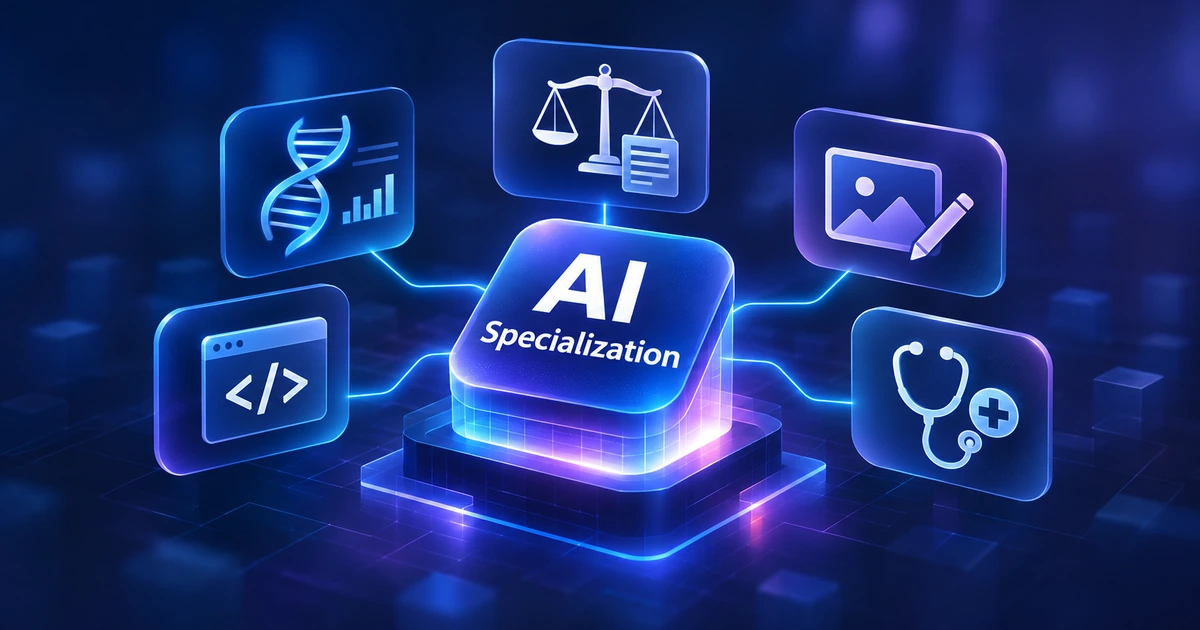
This shift toward AI specialization can already be seen in legal work, creative software, development environments, scientific research, and other fields. A legal team can use AI inside a document-review process. A designer can generate and modify content without leaving an image editor. A scientist can use a model built for a specific biological prediction problem rather than a conversational assistant.
The main idea: AI specialization does not necessarily mean a smaller model trained for one industry. A general model can become part of a highly specialized system when it is connected to the right context, software, tools, constraints, and workflow. The emerging pattern is therefore not “specialized AI replaces general AI,” but a layered ecosystem in which both increasingly work together.
What Does AI Specialization Actually Mean?
Calling an AI tool “specialized” can hide an important distinction. AI specialization can happen at different layers.
| Layer | What Is Specialized? | Example |
|---|---|---|
| Model | The model is designed or trained for a particular type of input, prediction, or domain. | A genomic model built to predict biological effects from DNA sequences. |
| Application | General model capabilities are combined with domain-specific data, interfaces, retrieval, permissions, or controls. | A legal AI platform built around document review and professional knowledge. |
| Workflow | AI is embedded into the sequence of actions required to complete a particular job. | Generative editing built directly into a professional image-editing process. |
These layers can overlap. A specialized application may use a specialist model, a general model, or several models, while a specialized workflow may combine AI with conventional software, search, databases, rules, and human approval.
This is why asking only “Which model does this tool use?” is increasingly incomplete. The model matters, but so does everything that determines what information reaches it, which actions it can take, how its output is structured, and how the result fits into real work.
AI specialization is increasingly about adapting the complete system to a job—not merely training a different model.
Why AI Is Becoming More Specialized
General-purpose AI is attractive because it is flexible. That same flexibility can also push setup and coordination back onto the user.
A professional repeatedly using a general assistant for the same task may need to find the relevant documents, provide context, define the required output, move the result into another system, and check it. For an occasional task, that may be perfectly reasonable. When the same job happens every day across a team, those extra steps become part of the cost.
AI specialization can reduce three kinds of friction in particular: repeatedly supplying the right context, moving work between systems, and evaluating outputs without criteria tied to the actual job.
Context matters because a powerful general model does not automatically know an organization’s current contracts, internal knowledge, customer records, project files, or permission structure. Appropriate access to relevant information can sometimes matter more for a specific task than simply moving to a more capable general model.
Integration matters because generating an answer may solve only one stage of the work. If the result ultimately needs to become a code change, edited image, reviewed contract, support action, or structured record, a specialized system can connect AI more directly to what happens next.
Evaluation matters because a bounded job gives teams more meaningful questions to ask. Instead of deciding whether an AI system is broadly “good,” they can measure whether it correctly extracts required fields, reduces review time, completes an authorized action, produces an acceptable draft, or performs a particular prediction well enough for the intended use.
Three Ways AI Specialization Is Already Happening
The distinction becomes clearer when we look at systems that specialize in different ways.
Harvey: Specialization Around Professional Legal Work
Harvey provides a useful example of specialization above the foundation-model layer.
In 2025, Harvey announced expanded model offerings that included models from Anthropic and Google alongside OpenAI models. A professional AI platform can therefore remain specialized even when its underlying models come from several general-purpose providers.
The specialization instead appears in the system around those models. Harvey’s Vault product is designed around legal document review, shared knowledge, structured review tables, collaboration, and integrations with document systems such as iManage, SharePoint, and Google Drive.
A general assistant could perform parts of that work when given the documents, context, instructions, and appropriate review. A specialized application attempts to make more of those requirements part of the working environment itself.
That does not independently prove that every Harvey output is more accurate than one produced with a general assistant. It demonstrates a different point: specialization can come from the application and workflow even when the underlying model is broadly capable.
Photoshop: Generative AI Inside an Existing Workflow
Adobe Photoshop illustrates specialization through workflow integration.
Generative Fill in Photoshop places AI generation inside an environment already built for selecting, editing, combining, and refining visual material. The user can work on a specific area of an image and continue editing the result rather than treating generation as an isolated final step.
Adobe also supports Adobe Firefly and partner AI models within parts of this workflow. The model can therefore change while the professional editing environment remains the specialized layer.
The value is not simply that Photoshop can generate pixels. It comes from combining generation with selections, layers, existing assets, editing controls, and the rest of the production process. A general assistant may also create or modify an image, but for professional work, what happens before and after generation can matter just as much.
AlphaGenome: Specialization at the Model Level
Some AI systems are specialized in a more fundamental way.
Google DeepMind’s AlphaGenome is designed for predicting how genetic variants affect regulatory activity. Research published in Nature describes a DNA-sequence model that processes 1 Mb of DNA sequence and predicts thousands of functional genomic tracks across diverse modalities.
This is not simply a general chatbot placed inside a scientific interface. The inputs, outputs, architecture, evaluation, and intended scientific task are themselves specialized.
A general AI assistant might still help a researcher explain a paper, write analysis code, organize findings, or explore ideas. But those abilities are different from performing the biological prediction for which a specialist model was designed.
Together, Harvey, Photoshop, and AlphaGenome show why AI specialization should not be treated as one technical category. Specialization can exist in the model, the product around it, the workflow—or several of those layers at once.
Why Specialized AI Can Be a Better Fit
The strongest argument for specialized AI is not that specialization automatically creates a smarter model. It is that a system designed around a bounded job can remove friction that a general interface leaves to the user.
- Relevant context can already be connected. Users may not need to repeatedly collect and upload the same information.
- The interface can match the job. A designer, developer, lawyer, or support agent may work through controls and objects that make sense for that profession.
- Outputs can be structured for the next step. The result may become part of a document review, code change, image edit, support record, or another operational process.
- Permissions can be narrower. A system can be given only the information and actions required for a defined workflow.
- Evaluation can focus on the real task. Teams can measure accepted results, correction effort, failure rates, or other job-specific outcomes instead of relying only on broad AI benchmarks.
These are potential advantages, not guaranteed outcomes. A poorly designed specialized product can still add complexity, produce errors, or solve a problem that users did not have.
Specialized Does Not Automatically Mean Better
The word “specialized” can sound like evidence of superior performance. It is not.
A useful reality check comes from healthcare, where ambient AI systems are designed specifically to help clinicians with documentation.
A randomized trial published in NEJM AI in 2025 involved 238 physicians across 14 specialties and evaluated two ambient AI scribe products. Nabla users experienced a statistically significant reduction in time spent writing notes compared with the control group, while Microsoft DAX users did not show a statistically significant reduction on that primary measure. The study also reported occasional clinically significant inaccuracies.
The lesson is not that specialized clinical AI works or fails as a category. Outcomes depend on the particular system, task, users, implementation, and metric.
Specialization changes the fit, not the standard of evidence: A product designed for one profession or workflow should still be evaluated on representative work. Domain branding, integration, and a focused interface do not prove accuracy, productivity, or reliability.
The same principle applies elsewhere. An integrated tool may eliminate copying between applications while introducing a new subscription and vendor dependency. A narrow workflow may reduce prompting while requiring configuration and maintenance. An AI agent may complete more steps while increasing the consequences of a wrong decision.
Specialization can make the problem clearer. It does not make the problem automatically solved.
The Hidden Cost of Too Many Specialized AI Tools
There is a point at which AI specialization can create a new kind of friction.
If every recurring task receives its own AI product, users and businesses can end up with overlapping subscriptions, scattered context, separate permission systems, duplicated features, and more integrations to maintain.
Vendor lock-in can also become more significant when a product’s value comes from the workflow surrounding the model. Replacing a model API may be relatively straightforward; replacing a system that stores organizational knowledge, connects business applications, and encodes established review processes can be much harder.
Security changes as specialized systems receive deeper access. An AI tool that drafts text from information manually provided by a user has a different risk profile from one that can retrieve internal records, modify data, call external services, or take actions on the user’s behalf.
OWASP guidance on excessive agency emphasizes controls such as limiting functionality and permissions, maintaining authorization in downstream systems, and requiring human approval where appropriate. The more useful access an AI system receives, the more important those boundaries become.
Over-specialization can create another problem: a system may work well for the expected case but become awkward when a task crosses domains or falls outside the designed process. General-purpose AI remains valuable precisely because many real problems do not fit neatly into one category.
Why General-Purpose AI Is Not Going Away
The growth of AI specialization does not mean the future belongs only to narrowly focused products.
General assistants remain useful because people regularly move between unrelated tasks: researching one topic, analyzing a file, drafting a message, writing code, exploring an idea, or working across several applications. Building a separate interface for every occasional need would sacrifice much of the flexibility that made general-purpose AI useful in the first place.
The boundary is also becoming less rigid. General assistants can use connected applications and specialized capabilities, while specialized products can rely on general foundation models underneath. OpenAI’s introduction of apps in ChatGPT and its Apps SDK, for example, demonstrated how external services can operate through a broader conversational environment.
General AI can become the interface to specialized capabilities, while specialized products can use general AI as infrastructure.
The distinction therefore matters less as a label than as a question of fit. A user may rely on a broad assistant for varied work and turn to a specialized system only where deeper context, integration, or control provides a meaningful advantage.
When Should You Choose a Specialized AI Tool?
The rise of specialized AI is not a reason to collect more tools. It is a reason to examine recurring work more carefully.
A general-purpose assistant may be enough when tasks vary frequently, the required context is easy to provide, the output is simple to review, and there is little benefit from integrating AI deeply into another system.
A specialized product becomes more interesting when the same bounded job happens repeatedly and important friction exists around that job.
| Situation | What to Consider |
|---|---|
| Tasks change frequently | A general assistant may provide enough flexibility. |
| The same workflow repeats often | Specialization may remove repeated setup and handoffs. |
| Work depends on specific internal data | Compare retrieval, permissions, and integration—not only model quality. |
| The output must enter professional software | An embedded or specialized workflow may reduce manual transfer. |
| Errors have serious consequences | Prioritize evaluation, review, permissions, and verification over convenience. |
| Several tools already overlap | Check whether another specialist product removes enough friction to justify added complexity. |
A hybrid approach can also make sense. A general assistant might handle exploration, brainstorming, or early research, while a specialized system handles a production stage where structure, integrations, permissions, or repeatability matter more.
If you are comparing products for a particular job, our guide on how to choose the right AI tool provides a broader framework for evaluating capabilities, workflow fit, cost, privacy, and practical constraints.
What Businesses Should Evaluate Before Specializing
For organizations, AI specialization changes the buying question.
Instead of beginning with “Which AI model should we adopt?” it can be more useful to ask: Which part of our work are we trying to improve, and what prevents it from working better today?
A practical evaluation can begin with five questions:
- What is the recurring job? Define the actual unit of work rather than a broad goal such as “use AI in legal” or “automate support.”
- What is the current baseline? Measure time, correction effort, failures, cost, or another outcome before assuming AI improved it.
- What does the AI need access to? Identify the data, software, permissions, and actions required to produce the result.
- Which failures are unacceptable? Decide where validation, human review, restricted permissions, or approval should remain.
- Does specialization create enough additional value? Compare the complete process—including setup, review, maintenance, switching costs, and subscription costs—not just generation speed.
Organizations can then compare three broad approaches: configure capabilities already available in an approved general platform, adopt a specialized product, or build a tailored system around models and existing software. Each option moves costs and responsibilities rather than eliminating them. The right comparison includes workflow fit, evaluation, security, maintenance, switching costs, and the measurable result—not only model capability.
For repeatable processes, our guide to building a practical AI workflow explains how to map the existing job, decide where AI belongs, test the complete process, and automate only after the workflow becomes stable.
The Next Phase of AI May Look More Unified—and Become More Specialized Underneath
AI specialization is likely to continue, but that does not necessarily mean users will end up opening a different AI application for every task. The opposite may happen at the interface level.
General assistants can become gateways to specialized capabilities. Professional software can absorb AI into existing workflows. Specialized applications can switch between foundation models behind the scenes. Highly specialized models can handle narrow computational problems while broader systems help users interpret and act on their results.
AI may therefore become more specialized underneath while appearing more unified to the user.
That changes what matters when evaluating an AI product. The question is no longer only how capable its model is, but whether the complete system has the right context, tools, integrations, boundaries, and evaluation process for the work being done.
General-purpose AI is not being replaced, and specialized AI is not automatically better. The important shift is where useful differentiation happens: increasingly, not only in the model itself, but in the context, tools, integrations, constraints, and workflow built around it.
The best AI system may not be the one that can do the most things. It may be the one that fits the work that actually needs to be done.