You open an AI assistant, type a question, and receive an answer seconds later. It can feel as if one intelligent system simply read your prompt and responded.
What actually happened may be more complicated.
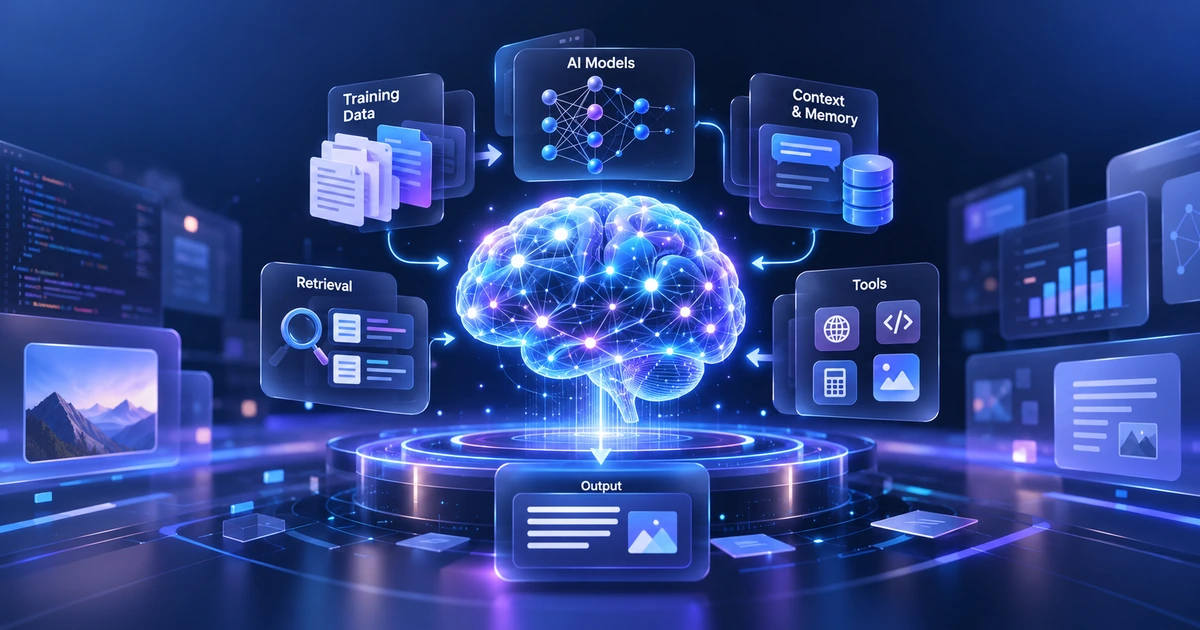
The product may have sent your request to an AI model, added instructions you never see, included conversation context, retrieved information from the web or your files, called a tool, and processed the result before displaying it.
AI Models are central to this process, but they are not necessarily the whole product.
Understanding that distinction explains why two AI products can behave differently even when they use similar models, why a large context window is not perfect memory, and why the highest benchmark score does not automatically identify the best tool for your work.
In this guide: We explain what AI Models are, how training and inference work, what tokens, parameters, context, memory, and retrieval mean, why models can produce convincing mistakes, and what all of this means when choosing an AI tool.
What Are AI Models?
An AI model is a computational system that has learned patterns from data and uses its learned parameters to produce predictions or generated outputs.
That definition covers much more than chatbots. AI Models can classify images, recognize speech, detect spam, recommend content, generate music, write code, create images, or produce text.
Modern neural-network models learn by adjusting numerical values called parameters. Together, those values influence how the model transforms an input into an output.
The word learned matters. Traditional software is largely built from rules explicitly written by programmers. A machine-learning model instead develops useful numerical relationships through training on data according to a defined objective.
This does not mean the model is simply a database containing a neat copy of everything it encountered during training. A database is designed to store records for later retrieval. A trained neural model uses learned numerical structure to compute outputs from inputs.
AI Models Are Not the Same as AI Products
This is one of the most important distinctions in modern AI:
The model generates or predicts. The product determines how that capability is used.
When you use an AI assistant, coding agent, research platform, or creative application, you are usually interacting with a software system built around one or more models.
| Layer | Role |
|---|---|
| Model | Processes inputs and produces predictions or generated outputs. |
| Context | Provides information available during the current interaction. |
| Retrieval | Finds relevant information from documents, databases, or other sources. |
| Tools | Allow operations such as search, calculation, code execution, or API calls. |
| Product | Combines models, context, tools, permissions, and interface features into the experience you use. |
A product can route different requests to different models or combine models with search, image generation, speech, code execution, and other capabilities.
This is why asking “Which model does this tool use?” is useful but incomplete. The surrounding product affects what information reaches the model, which tools it can use, and what the user can actually accomplish.
How Are AI Models Trained?
Training is the process through which a machine-learning model develops or adjusts its learned parameters.
The details vary between architectures, but the basic idea can be simplified:
Training Data → Prediction → Measure Error → Adjust Parameters → Repeat
Suppose a language model is being trained to predict the next token in text. It receives part of a sequence, predicts what is likely to come next, and that prediction is compared with the training target.
A mathematical measure called a loss represents how far the prediction is from the training objective. Techniques including backpropagation and optimization are used to determine how parameters should change to reduce that loss.
Repeated across enormous numbers of examples, this process allows the model to develop patterns useful for generating and interpreting information.
Pretraining and Post-Training
Pretraining generally builds broad capabilities from large datasets and general learning objectives. Post-training can then shape how those capabilities are expressed.
Depending on the system, post-training may involve instruction tuning, supervised examples, preference optimization, reinforcement-learning methods, safety training, or related techniques.
This is one reason the quality of AI Models cannot be reduced to parameter count. Architecture, data, compute, objectives, and post-training all matter.
Training and Inference Are Different
Training creates or modifies the model’s learned state. Inference is what happens when a trained model processes a new input.
Your Prompt + Available Context → Trained Model → Generated Output
The product prepares information for the model. The model processes it using its existing parameters and generates an output. An autoregressive language model typically produces that output token by token.
This corrects a common misconception. If you tell an AI assistant your preferred writing style, the underlying model does not normally retrain itself immediately. Your instruction can instead become part of the context supplied during inference.
A product might separately save information through a memory feature, but that is a different mechanism.
Tokens, Parameters, Attention, and Context
These terms describe different parts of how modern AI Models work.
Tokens
Language models usually process text as units called tokens. A token can represent a word, part of a word, punctuation, part of a number, or another unit determined by the tokenizer.
There is no universal rule that one token equals one word. Tokens matter because they influence how much information can fit into an interaction and, particularly with APIs, how usage may be measured or billed.
Parameters
Parameters are numerical values learned during training. Together, they influence how the model transforms inputs into outputs.
Some models contain billions of parameters, but more parameters do not automatically mean better results. Architecture, data, specialization, and training also matter.
Attention
Attention mechanisms allow transformer-based models to calculate relationships among elements of the information they process.
The transformer architecture became foundational to modern language AI after the 2017 research paper Attention Is All You Need.
The practical idea is simpler than the mathematics: different parts of an input can matter differently depending on the task and surrounding information.
Context
Context is the information available to a model during a particular invocation. It can include your prompt, system instructions, conversation history, uploaded material, retrieved passages, tool results, and previously generated text.
A context window limits how much information the system can process at once. But a large context window is not perfect memory. Information fitting inside the context does not guarantee that every detail will be used correctly.
Weights, Context, Memory, and Retrieval Are Different
When AI Models appear to “know” something, that information may have reached the response in several ways.
| Source | What It Means |
|---|---|
| Model weights | Learned numerical state created or modified during training. |
| Current context | Information supplied for the current interaction. |
| Conversation history | Earlier messages a product may include in later context. |
| Saved memory | Information stored outside the core model and reused by the application. |
| Retrieval | External information found and supplied when needed. |
A model can therefore have a training-data cutoff and still answer a newer question if the product retrieves current information and supplies it as context.
The model did not retrain itself on the new information. The surrounding system gave it additional evidence.
Where RAG Fits In
Retrieval-augmented generation, or RAG, combines information retrieval with generative AI.
A system can search documents or another information source, identify relevant material, and provide selected passages to the model before it generates an answer.
This can be useful for research collections, company knowledge bases, private files, and frequently changing information.
But RAG does not guarantee accuracy. Retrieval can find the wrong information, and the model can still misunderstand correct evidence. Citations improve verifiability without becoming a guarantee of truth.
Why Can AI Models Sound Right and Still Be Wrong?
Fluent output and factual accuracy are not the same thing.
A model can generate a confident explanation containing incorrect, fabricated, or unsupported information. This is commonly called an AI hallucination or, in some risk frameworks, confabulation.
It is misleading to think of this as the model consciously deciding to lie. Generative models produce outputs according to learned patterns, available context, and their generation process. Plausible language does not guarantee that every statement corresponds to reality.
Not every incorrect answer is a model failure either. Search may retrieve an outdated source, an external service may return bad data, the product may omit important context, or a tool may fail.
Reliability belongs to the complete AI system, not only to the model.
The NIST AI Risk Management Framework provides a broader framework for thinking about AI risks and trustworthy use.
For brainstorming, occasional errors may be easy to tolerate. For research, production code, medical or financial information, and published factual claims, verification becomes much more important.
What Are Reasoning Models?
Some modern AI Models are described as reasoning models.
In practical terms, these systems can be trained or configured to spend additional inference effort on a problem before producing a final answer. This can improve performance on tasks involving mathematics, coding, planning, or several dependent steps.
That does not establish that a model thinks in the same way a human does. A displayed reasoning summary should also not automatically be treated as a perfect transcript of the model’s internal computation.
For users, the practical question is whether additional reasoning improves the final result enough to justify any extra time or cost.
Why Are AI Models Different From One Another?
There is no single model design that is best for every task. Models can differ in architecture, training, modalities, size, specialization, openness, speed, cost, and deployment requirements.
Language and Multimodal Models
Language models focus heavily on sequences such as text and code. Multimodal models can work with more than one type of information, such as text, images, audio, or video.
But “multimodal” is not a complete specification. A model might accept images and produce only text, while another system can generate images or audio.
When comparing them, ask two questions: What can the system receive, and what can it produce?
Size, Efficiency, and Openness
Larger models can have more capacity, but parameter count is not a universal measure of intelligence or usefulness.
Some models use mixture-of-experts architectures, where only selected components are activated for a particular input. Techniques such as distillation can transfer useful behavior into smaller models, while quantization can reduce memory and computational requirements by using lower numerical precision.
Model openness also requires careful terminology. An open-weight model makes its learned weights available under specified terms, but that does not automatically mean the entire system is open-source. Code, weights, training information, data, documentation, and licensing are separate questions.
Local vs. Cloud Models
Some AI Models can run on hardware controlled by the user, while others are mainly accessed through cloud infrastructure.
Local inference can provide greater control over where computation occurs and may support offline use. But local does not automatically mean private. An application can still send telemetry, synchronize information, or connect to online services.
Cloud systems can provide access to powerful models without requiring users to operate the underlying infrastructure. The trade-offs may include connectivity, provider dependency, pricing, and data policies.
Why Benchmarks Do Not Tell the Whole Story
AI model launches often include benchmark charts showing performance in mathematics, coding, reasoning, science, and other areas.
Benchmarks are useful evidence. They are not universal rankings of which model will be best for you.
A coding benchmark may not reflect your repository, dependencies, tools, or review process. Results can also depend on prompts, model versions, tools, reasoning settings, and scoring methods.
Use benchmarks to understand capabilities and help create a shortlist. For important work, test the actual product on representative tasks.
The useful question is not simply “Which model scored highest?” It is “Which system produces an acceptable result for this job under the conditions in which I will actually use it?”
One Prompt Can Involve Several AI Layers
Consider this request:
“Find the latest renewable-energy data, summarize the main changes, and create a chart.”
One interface can make this look like a single AI task. In reality, several components may be involved:
- The product receives the request and prepares relevant instructions and context.
- The model interprets the goal and identifies that current information is required.
- Search or retrieval finds sources outside the model’s learned weights.
- The model analyzes the retrieved information.
- A calculation or code tool processes the data.
- A visualization component creates the chart.
- The product assembles the final response.
If the chart contains an incorrect number, the source could be wrong, search could retrieve outdated information, the model could misunderstand the data, or another component could process it incorrectly.
This becomes even more important when AI can take actions rather than only generate answers. An AI agent, for example, can combine a model with tools, permissions, and orchestration to work through multiple steps toward a goal.
Privacy Depends on More Than the Model
Knowing which model a product uses does not tell you how your information is handled.
Privacy can depend on the service, account type, deployment, settings, connected tools, and provider policies.
Separate questions such as what information the service receives, how long it can be retained, whether it may be used for model improvement, what is stored as product memory, and which connected services can access it.
“Not used for training” does not necessarily mean “not stored.” Training, retention, memory, logging, and deletion are different processes.
When sensitive information matters, evaluate the policies and controls of the exact product and account type you intend to use.
What Do AI Models Mean When Choosing an AI Tool?
Understanding AI Models is useful, but most people are ultimately choosing a complete AI product.
A technically impressive model can still be the wrong choice if the product lacks the integrations, privacy controls, file support, workflow features, reliability, or pricing structure you need.
Ask whether the product performs your real task well, whether important outputs can be verified, whether it can access the information you need, how much correction is required, how your data is handled, and what useful work actually costs.
This is why there is rarely one universally “best AI model.” A powerful general-purpose model may be unnecessary for a simple high-volume task. A smaller model may provide lower latency or easier local deployment. A specialized product may perform better because its entire workflow is designed around one type of work.
If you are comparing products rather than studying the underlying technology, our guide on how to choose the right AI tool provides a practical framework for evaluating products against your actual workflow instead of choosing from feature lists or model rankings alone.
The Useful Way to Think About AI Models
AI Models become easier to understand once you stop treating the model and the product as the same thing.
The model provides learned computational capability. Training creates or adjusts that learned state. Inference applies it to new inputs. Context provides information for the current interaction. Retrieval can bring in external evidence. Memory can preserve selected information outside the core model. Tools can allow the surrounding system to perform actions the model could not perform by generating an answer alone.
Each layer changes what an AI product can do—and where things can go wrong.
A bigger model is not automatically better for every task. A larger context window is not perfect memory. Search is not a guarantee of truth. Reasoning is not a guarantee of correctness. And a famous model does not automatically make the product around it the right tool for your work.
The model matters. But the system around the model determines much of what you actually experience.
So instead of asking only:
“Which AI model is the smartest?”
Ask a more useful question:
“Which complete AI system can reliably do the work I need, with the information, tools, privacy, cost, and level of control that matter to me?”
That question is less exciting than a leaderboard.
It is also much more useful.